
Diabetic foot ulcers, start to finish
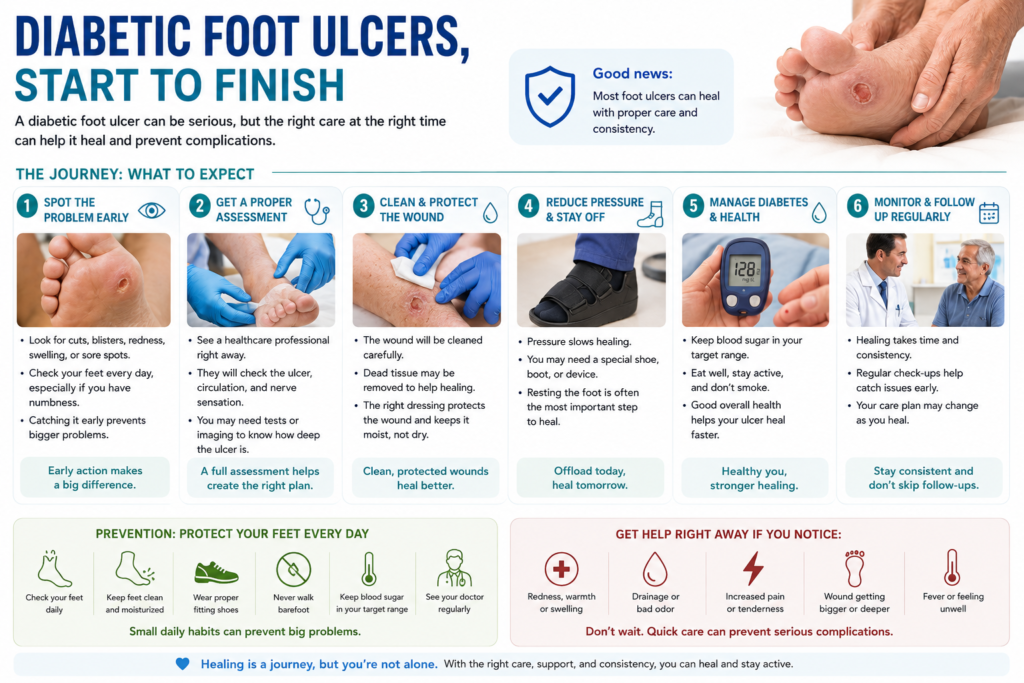
Most guides on this subject open by trying to frighten you. This one will not, but it will be direct about one thing: a wound on the foot of someone with diabetes behaves differently from a wound anywhere else on the body, and treating it like an ordinary sore is the mistake that causes most of the harm.
Here is why, and here is what to actually do.
Three things go wrong at once
Nerves. Long-term high blood glucose damages the small nerves in the feet. This is peripheral neuropathy, and it usually starts in the toes and works upward. It takes away the warning system. A stone in your shoe, a seam rubbing, a new blister, a burn from bathwater that was too hot. Normally pain would make you stop. Without it, you keep walking, and the damage keeps going.
Neuropathy also dries the skin, because the nerves controlling sweating are affected too. Dry skin cracks, and cracks are entry points.
Blood supply. Diabetes accelerates narrowing of the arteries, including the small ones below the knee. Less blood arriving at the foot means less oxygen, fewer immune cells, and less of any antibiotic you take. A wound that would close in ten days on a well-supplied foot can sit open for months.
Shape and pressure. Neuropathy changes the small muscles of the foot, which changes how the toes sit and how the arch loads. Pressure concentrates in new places. The body responds by building callus, the callus raises pressure further, and the tissue underneath breaks down, often before the surface does. This is why an ulcer sometimes seems to appear fully formed under a patch of hard skin.
Together you get a foot that does not feel injury, cannot easily repair it, and reloads the injured spot with every step.
Why “it’s only small” is the dangerous sentence
Small ulcers on the foot do not stay small in a predictable way. They hold steady for a while and then deteriorate quickly.
Infection is the reason. The tissue planes of the foot let infection travel along tendons into deeper compartments, and the bones sit close to the surface, so infection can reach bone faster here than almost anywhere else in the body. Because sensation is reduced, the signal that would normally tell you this is happening may be muted or absent entirely.
Foot ulcers are also the event that precedes the large majority of diabetes-related lower limb amputations. That is not there to alarm you. It explains why your clinician will want to see a small foot wound urgently while being relaxed about a similar wound on your arm. They are not overreacting. The stakes on the foot are different.
Offloading: the part that does the healing
If compression is the treatment for venous ulcers, offloading is the treatment for diabetic foot ulcers. It means taking pressure off the wound so tissue can repair without being crushed a few thousand times a day.
Willpower does not count as offloading. “I’ll walk carefully” and “I’ll stay off it as much as I can” are not treatments, and this is well documented. What works is a physical device that removes the load whether or not you remember to be careful.
Total contact cast. A cast over the lower leg and foot that spreads load across the whole surface. The most effective option for ulcers on the sole. Its main advantage is that you cannot take it off, which is also its main inconvenience.
Irremovable walker. A removable boot that is then wrapped or banded so it stays on. Nearly as effective and easier to apply.
Removable cast walker or boot. Works well when worn. The gap between prescribed and actual wear time is where healing is usually lost.
Felted foam padding, offloading insoles, half shoes. Useful for particular sites, or when the options above cannot be tolerated.
Whatever you are given, wear it for every step, including the short ones. Getting up in the night on a bare foot undoes real progress. Keep the device by the bed.
Debridement, and why the callus keeps being cut away
At most appointments a clinician will pare back callus and dead tissue around the ulcer. This is not tidying. Callus around a wound acts like a rim that holds the edges apart and concentrates pressure, and removing it repeatedly is associated with faster healing. Dead tissue also feeds bacteria and blocks new tissue from advancing.
Do not do this yourself. No blades, no corn removers, no pumice on an open wound, and no over-the-counter callus plasters, which are usually acid-based and can burn a neuropathic foot without you feeling it.
Checking your feet in a way you will keep doing
Once a day, attached to something you already do. After a shower works well.
- Look at the top, sole, sides, and heel of both feet. Use a mirror on the floor or on a stand if bending is difficult, or ask someone.
- Look between every toe. This is where moisture collects and skin breaks down.
- Feel for warm spots. A patch noticeably warmer than the same place on the other foot can come before anything is visible.
- Check for new callus, cracks, blisters, colour changes, or anything that was not there yesterday.
- Before putting shoes on, run your hand inside them. Seams, folds, small stones, objects that fell in.
Report anything new that week, not next month.
What good treatment looks like
Your care should involve more than a dressing. Expect:
A vascular check. Pulses, and usually pressure measurements. In diabetes, ankle readings can be falsely high because the arteries are stiffened, so toe pressures are often more reliable. If blood supply is poor, restoring it may be the thing that unlocks healing.
Assessment for infection and bone involvement. If the ulcer is deep, a clinician may gently probe it. Touching bone through an ulcer considerably raises the likelihood of bone infection and changes the plan.
Blood glucose management. Glucose affects immune function and tissue repair. This is a mechanical point, not a moral one.
A dressing matched to the wound. Enough absorbency for the fluid without drying the wound bed out.
A four-week review point. If the ulcer has not reduced by roughly half after four weeks of good care, the plan should change rather than continue.
After it heals: remission, not cure
When a diabetic foot ulcer closes, the foot is not back to normal. The nerves are still damaged, the pressure points are still there, and the new skin is thinner than what it replaced. Recurrence within a year is common, and within a few years it is more likely than not.
What lowers that risk is properly fitted therapeutic footwear and custom insoles worn indoors as well as out, continued daily checks, regular podiatry review rather than waiting for the next problem, and keeping the same offloading habits around any area that has healed.
It is remission that has to be maintained, in the same way as any other long-term condition.
Get seen the same day if
- The redness is spreading up the foot or ankle.
- There is a bad smell, new drainage, or pus.
- The foot becomes suddenly hot, swollen, or red, particularly if it is also changing shape.
- Any tissue turns black, or a new blister appears.
- You have a fever or chills, or your glucose readings climb without an obvious explanation, which can be an early sign of infection.
- Pain increases significantly in a foot that usually does not feel much.
If you cannot reach your usual team, this is a reason to use urgent care rather than wait. Speed genuinely changes outcomes here.