
Choosing between dressing types
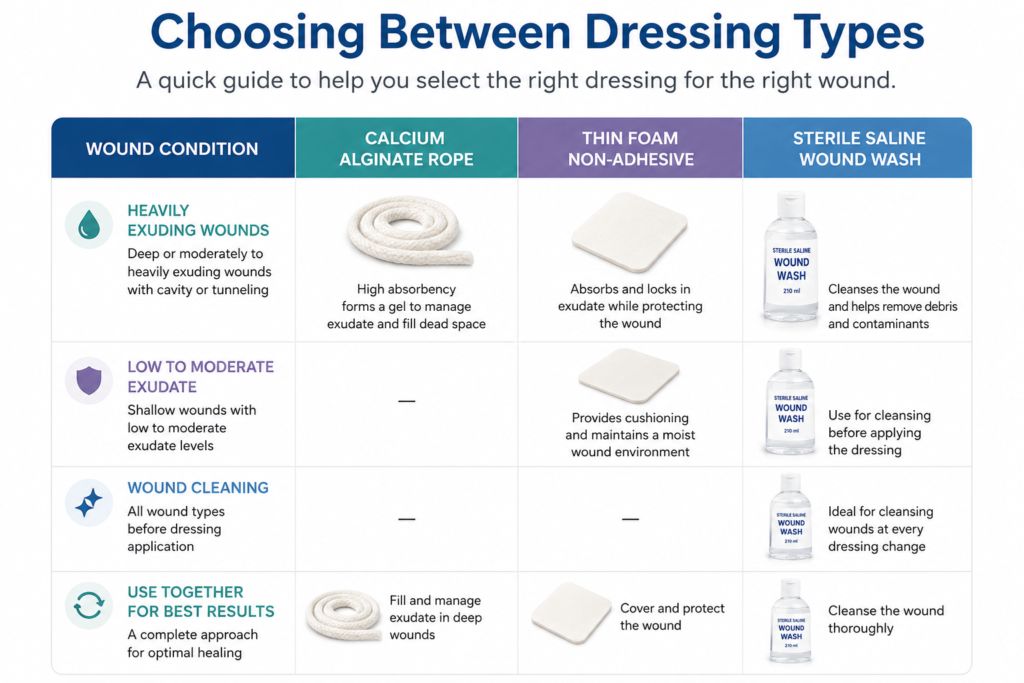
The pharmacy aisle is not organised in a way that helps. Packets say things like advanced, hydroactive, and healing accelerator, and none of that tells you whether the product suits your wound. What actually matters is much simpler, and it comes down to a handful of questions.
The principle underneath all of them
Wounds heal faster when the surface is kept moist, and slower when it dries out and forms a hard scab. New cells migrate across a moist surface. They cannot cross a dry crust, so they have to burrow underneath it, which takes longer.
The catch is that too much moisture is also a problem. Excess fluid sitting on the skin around the wound breaks it down, turning it white and soggy. That enlarges the wound.
So the job of a dressing is to hold the wound bed at the right level of moisture. Which is why there is no single best dressing. There is a best dressing for how wet your wound is today, and that may not be the right one in three weeks.
Four questions that decide it
- How much fluid is coming out? Look at the dressing you just removed. Barely marked, damp in the middle, soaked to the edges, or leaking past them?
- What is the wound bed made of? Red or pink healthy tissue, yellow or stringy dead tissue, or dry black leathery tissue.
- Is there a cavity or a tunnel? Depth needs filling, not just covering.
- How fragile is the surrounding skin? Thin, papery, or already irritated skin rules out aggressive adhesives.
Then one practical question: how often can this realistically be changed? A dressing needing daily changes is a poor choice for someone who cannot reach their own heel.
The main types
Foam
For: moderate to heavy fluid. The everyday workhorse for venous ulcers, pressure injuries, and surgical wounds that are still draining.
Foam absorbs fluid into its structure and holds it away from the skin. It cushions, which matters over a bony point, and it comes with or without an adhesive border, in flat sheets and in shapes cut for heels and the tailbone. Silicone-backed versions release without tearing skin, worth asking for if changes are painful.
Not for: dry wounds, which it will dry out further.
Typical wear time: two to five days, sometimes up to a week, depending on fluid.
Hydrocolloid
For: light fluid, and shallow wounds with some yellow dead tissue that needs softening.
Hydrocolloids form a seal over the wound. They trap the body’s own moisture, which gradually softens and lifts dead tissue. This is the gentlest way of cleaning a wound up.
The thing to know in advance: as it works, a hydrocolloid turns into a yellow-brown gel, and when you take it off it looks and smells like pus. This is normal and is not infection. A lot of people panic at their first change, and there is no reason to.
Not for: heavy fluid, deep cavities, wounds with dead tissue that needs removing quickly, or wounds that are or may be infected, since sealing an infected wound is a bad idea. Also poorly suited to very fragile surrounding skin, as the adhesive is firm.
Typical wear time: three to seven days.
Alginate
For: heavy fluid, and cavities that need packing.
Made from seaweed, alginate arrives as a dry fibrous sheet or rope and turns to gel as it absorbs. It holds a lot of fluid for its size, conforms into a cavity, and has a mild ability to slow minor bleeding, which makes it useful after debridement.
It has no adhesive, so it always needs a second dressing over the top, usually a foam or a film.
Not for: dry or lightly draining wounds. If an alginate comes out dry and stuck, it was the wrong choice and it will hurt to remove. Soak it off rather than pulling.
Typical wear time: one to three days, driven by how fast it saturates.
Hydrogel
For: dry wounds, and wounds with hard dark dead tissue that needs softening.
Hydrogel does the opposite of the others. It donates water rather than absorbing it. Applied to a dry wound bed or over dead tissue, it rehydrates and helps the body break that tissue down. It also has a cooling effect that some people find noticeably soothing on a painful wound.
It needs a secondary dressing to keep it in place.
Not for: wounds that are already wet. Adding moisture to a draining wound damages the surrounding skin quickly.
Typical wear time: one to three days.
The others you will run into
Film dressings. Thin transparent adhesive sheets. Waterproof, breathable, and see-through. Good for protecting intact skin from friction, covering very shallow wounds with almost no fluid, and holding another dressing on. They have essentially no absorbency, so used alone on a draining wound they trap fluid against the skin.
Silicone contact layers. A soft, non-stick mesh placed directly on the wound with an absorbent dressing over it. The contact layer can stay put for several days while the outer dressing is changed, so the healing surface is disturbed far less often. Worth asking about if your dressing changes are painful or your skin tears easily.
Antimicrobial dressings. Silver, iodine, honey, and PHMB versions of the dressings above. These are for wounds where bacteria are genuinely holding back healing, not for routine use. The usual approach is a defined trial, often around two weeks, with a clear decision at the end to continue, stop, or change the plan. Leaving an antimicrobial on indefinitely is not good practice and adds cost without benefit.
Superabsorbent pads. For wounds producing more fluid than a foam can handle, especially heavily leaking venous legs.
Negative pressure wound therapy. A sealed dressing attached to a pump that draws fluid away and pulls the wound edges together. Used for large or deep wounds, and always set up and supervised by a clinician.
Reading your own dressing
The dressing you just took off is the most useful information you have.
- Dry, and stuck to the wound. Too absorbent, or changed too infrequently. You need something that keeps more moisture in.
- Damp in the middle, dry at the edges. About right. Keep going.
- Soaked through to the edges, or leaking. Not absorbent enough, or needs changing more often. Move up a level.
- White, soggy skin around the wound. Moisture is escaping onto the skin. Increase absorbency, change more often, or add a barrier film to the surrounding skin.
- A red, itchy, weepy rash in the exact shape of the dressing. This looks like a reaction to the adhesive or the product. Report it rather than pushing through. Sensitivity to dressing products is common in people with long-standing leg wounds.
Three habits worth having
Expect the dressing type to change as the wound changes. A wound that starts heavy and sloughy may need alginate early, foam in the middle, and something thin and protective at the end. Using the same product from start to finish usually means someone stopped reassessing.
Do not choose on packaging claims. Match the category to the fluid level and the wound bed. Within a category, brands are broadly similar, and the cheaper one you can actually get hold of and afford is usually the better choice.
Check what you have been given. Many people leave the clinic without knowing which of these is on their leg. Ask for the name, write it down, photograph the box, and ask what to buy when you run out.
Ask before changing anything if
- The wound is or may be infected. Several of these are unsuitable in that situation.
- You can see bone, tendon, or other exposed structures.
- The wound has a cavity or a tunnel, which needs correct packing rather than covering.
- You have significant arterial disease, or diabetes affecting the foot, where dressing choice interacts with blood supply.
- Dry, stable black eschar is present, particularly on a heel. Rehydrating it can be exactly the wrong move.
Use this to understand the choice your care team has made rather than to overrule it.