
Compression, explained honestly
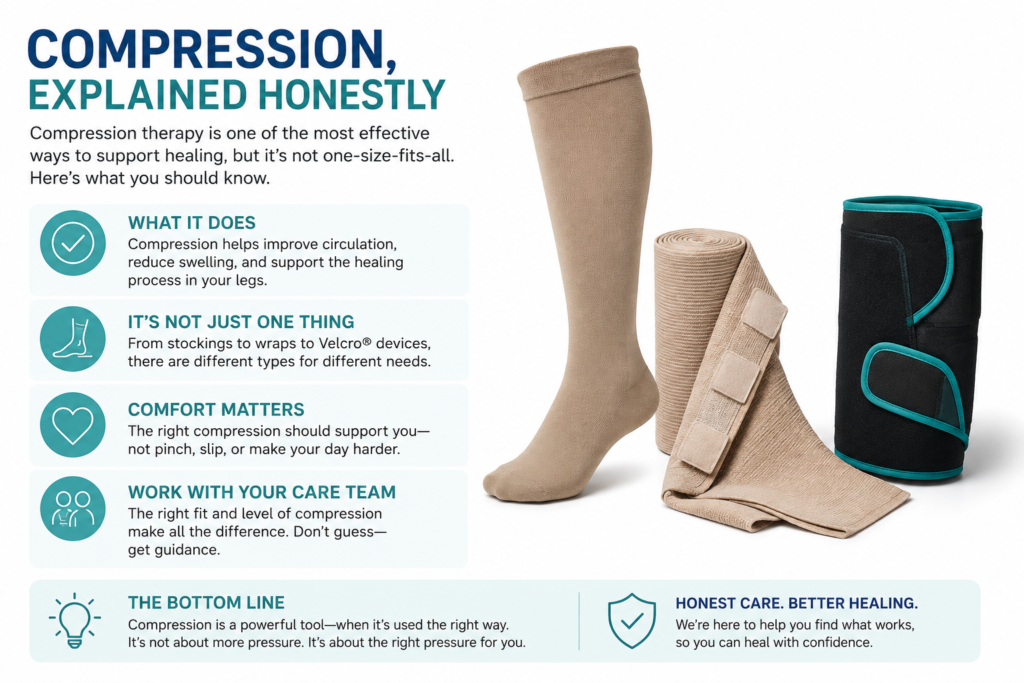
Compression is the most effective treatment there is for venous leg ulcers and long-term leg swelling. It is also the treatment people quietly abandon most often, because nobody warned them what the first fortnight feels like or what is worth reporting.
So here it is without the marketing.
What it is doing to your leg
Your leg veins move blood upward using one-way valves and the squeeze of your calf muscle. When the valves fail, blood pools, pressure rises inside the veins, and fluid is forced out into the surrounding tissue. That fluid separates the cells, carries inflammatory chemicals with it, and makes it very difficult for skin to repair itself.
External compression works against this in several ways at once. It narrows the veins so the failing valves come closer to meeting again. It gives the calf muscle something firm to pump against, which moves blood and lymph fluid up out of the leg. It raises the pressure in the tissue so less fluid leaks out in the first place. And it reduces the swelling that is physically holding the wound edges apart.
There is a physical rule underneath this. The pressure a bandage delivers depends on how tightly it is applied and on how wide the limb is at that point. Because your ankle is narrower than your calf, the same bandage naturally delivers more pressure at the ankle and less further up. That gradient is what moves fluid in the right direction, and it is why bandaging is a skill rather than just wrapping something firmly.
The forms it comes in
Multi-layer bandaging. Several layers applied by a trained clinician, usually left on for up to a week. Delivers high, sustained pressure and copes with a lot of fluid. You cannot take it off yourself, and it will not fit in a normal shoe.
Short-stretch or inelastic bandaging. Firm material that resists the calf muscle when you walk, giving a strong pumping effect during movement and a gentler pressure at rest. Well suited to people who are walking regularly.
Adjustable wraps. Velcro-fastened garments you can tighten yourself. Much easier to manage independently, simple to re-tighten as swelling comes down, and often the difference between someone keeping this up or not.
Compression stockings. Come in defined strength classes. The right class depends on your circulation, your skin, and your ability to get them on. Usually the long-term option once an ulcer has healed.
Intermittent pneumatic compression. An inflatable sleeve driven by a pump, used for a set period each day. Helpful for people who cannot walk much or cannot tolerate bandaging.
The safety check that comes first
Compression pushes against the pressure in your veins. If the arteries bringing blood into your leg are significantly narrowed, adding external pressure can reduce a blood supply that is already limited, and that can cause serious harm.
This is why your clinician should assess your arterial circulation before applying compression, usually with an ankle-brachial pressure index. It takes a few minutes and involves a blood pressure cuff and a small ultrasound probe. In people with diabetes, ankle readings can be misleadingly high because the arteries are stiffened, so toe pressures may be used instead.
If nobody has assessed your circulation and someone is about to bandage your leg, it is reasonable to ask about it.
When compression is not safe, or needs closer supervision
- Significant arterial disease in the leg.
- Heart failure that is not currently well controlled, because moving a large volume of fluid out of both legs quickly puts load on the heart.
- An infection in the leg that has not yet been assessed.
- Severe loss of sensation, which needs care because you may not feel a bandage causing damage.
- A known allergy to the bandage or stocking materials.
None of these are automatic and permanent bans. Several mean a lower pressure, a different material, or closer monitoring rather than nothing at all. What they do mean is that the decision belongs to a clinician who has examined your leg.
What the first two weeks actually feel like
Nobody enjoys this part. Being told in advance helps.
Normal, and usually settling within a week or two:
- A firm, tight, held feeling. It should feel snug, not painful.
- Aching in the leg for the first day or two as fluid shifts.
- Awareness of the bandage at night, and some difficulty finding a comfortable position.
- Itching, particularly if your skin is dry.
- Shoes not fitting. You may need a larger shoe or a soft slipper on that foot.
- Bandages loosening as swelling drops, which is a sign it is working, though a very loose bandage should be reapplied rather than left.
Not normal. Loosen or remove the compression and get advice the same day:
- Numbness, pins and needles, or loss of feeling in the foot or toes.
- Toes that turn white, blue, or grey, or feel cold compared with the other foot.
- Pain that increases rather than settles, especially pain at night, or pain that eases when you hang your leg over the side of the bed.
- Sharp, localised pain over a bony point such as the shin, ankle bone, or top of the foot, which can mean the bandage is pressing too hard in one place.
- New skin damage, blistering, or a deep indentation where the bandage edge sits.
The instruction to remove it is deliberate. If something in this second list is happening, waiting until the next appointment is the wrong call.
Making it work in real life
Wear it every day, all day. Compression worn some of the time gives some of the benefit, and fluid returns quickly during the hours it is off. This is the single biggest predictor of whether the ulcer closes.
Put stockings on first thing in the morning, before your legs have had time to swell. It is far harder at six in the evening.
Use a donning aid. A metal frame, a silk slip-sock, or rubber gloves for grip. These turn an unmanageable task into a manageable one and are worth asking about specifically.
Keep walking. Compression and the calf pump work together. A bandaged leg that never moves gets much less out of it.
Elevate when you are resting, with the leg above heart level rather than just up on a stool.
Moisturise on the days the bandage is changed, using a plain unperfumed emollient, and give it a few minutes to absorb before reapplying.
Replace stockings regularly. The elastic tires. Most need replacing every three to six months, and a stocking that goes on easily is usually one that has stopped working.
The honest part
For many people this is not a temporary treatment. Once an ulcer has healed, ongoing compression is what stops it coming back, and the recurrence rate among people who stop is high. That is a genuinely tiring thing to be told, and finding it tedious does not mean you are failing at it.
If it is uncomfortable, difficult to put on, hot in summer, or interfering with your shoes and your life, say so rather than quietly stopping. There are different materials, different strengths, wraps instead of bandages, and aids that make it easier. A compression plan you can actually stick to beats an ideal one you cannot.