
Pressure injury stages in plain words
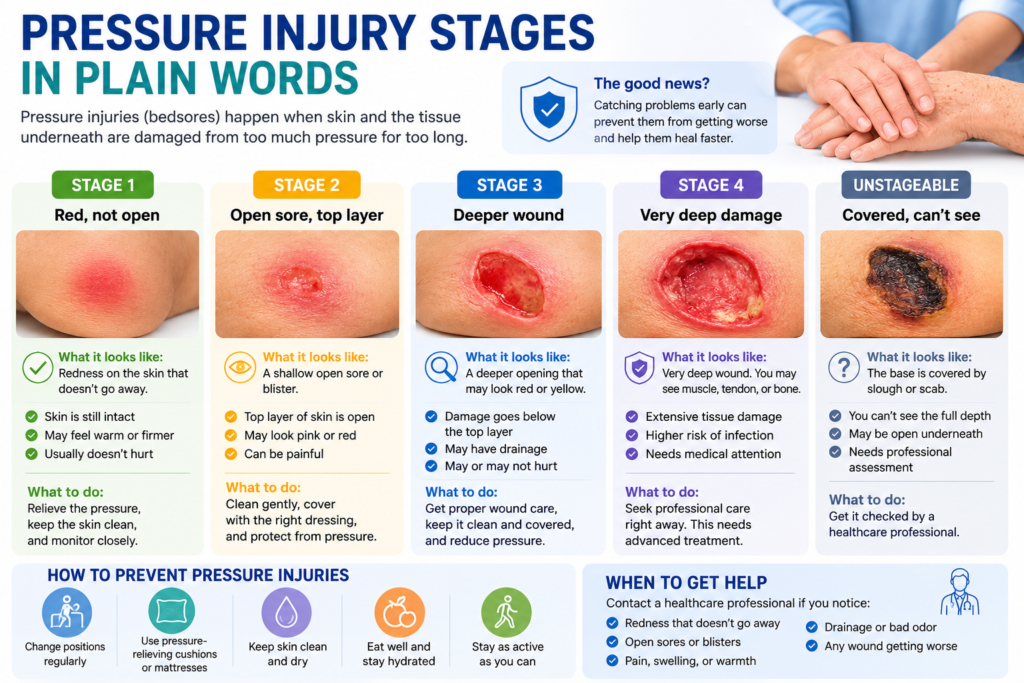
Someone has probably said a number to you. Stage 2. Stage 3. Unstageable. The number describes how deep the damage goes, and nothing else. It is not a score out of four, it does not tell you how serious your situation is on its own, and it does not predict how long healing will take.
Here is what each one means, and what changes about the care.
First, why they happen
Pressure injuries, also called pressure ulcers or bedsores, form when skin and the tissue underneath are squeezed between a bone and a surface for long enough that blood stops reaching them. Most form over bony areas: the tailbone, the hips, the heels, the shoulder blades, the back of the head, the ears, and anywhere a device presses, including oxygen tubing, catheters, and casts.
Two things make it worse than plain pressure. Shear, which happens when you slide down the bed and the skin stays put while the tissue underneath moves. And moisture, which weakens the skin surface and increases friction.
Stage 1: intact skin that stays red
The skin is not broken. There is an area of redness that does not go pale when you press it and release. The area may feel warmer, cooler, firmer, softer, or more painful than the skin around it.
On darker skin tones this is easy to miss, because the colour change can be subtle, or look purple, blue, or simply darker rather than red. Do not rely on colour alone. Compare temperature between the same spot on each side, feel for firmness or a boggy, spongy texture, and take reported pain seriously. Pressure injuries are caught late in people with darker skin more often than they should be, and this is a large part of why.
What changes: relieve the pressure now. Reposition, float the heels off the bed with a pillow under the calves rather than under the heel itself, and check the fit of anything resting on the area. Protect the skin with a barrier product or a soft silicone dressing. Do not massage it. Massaging damaged tissue makes it worse.
Stage 1 is reversible. It is also a warning that the pressure plan is not working, so treat it as information about the whole situation rather than one spot.
Stage 2: an open shallow wound in the top layers
The top layer of skin is gone and the wound bed is pink or red, moist, and shallow. It may look like a graze, a shallow crater, or an intact or burst blister filled with clear fluid.
You should not see fat, tendon, muscle, or bone. If you can, it is not Stage 2.
What changes: the aim is a moist, protected environment. Usually a thin foam, a hydrocolloid, or a silicone-backed dressing left in place for several days rather than changed daily. Pressure relief continues and gets stricter.
One clarification that matters. Stage 2 is only used for pressure damage. Skin tears, tape injuries, and the raw, weepy redness caused by long contact with urine or stool are different problems with different treatments, even though they can look similar. Moisture damage tends to spread across a broad area in skin folds rather than sitting over a bony point.
Stage 3: through the skin, into the fat
Full-thickness loss. The wound extends through both layers of skin and you can see fatty tissue in the base. Granulation tissue, the bumpy red new tissue that fills a healing wound, may be visible. The edges may be rolled under.
There may be undermining, where the wound is wider under the skin than the opening suggests, or tunnelling, where a narrow channel runs off from the wound. Depth varies a lot by location. Over the tailbone there is very little fat, so a Stage 3 there can be shallow. On the buttock it can be deep.
What changes: this needs a plan rather than a plaster. Expect dead tissue to be removed, the depth and any tunnels to be measured and recorded, dead space to be lightly packed so it heals from the base up rather than closing over a cavity, and a serious conversation about nutrition, because full-thickness wounds carry a real protein and calorie cost.
Stage 4: down to structure
Full-thickness loss with visible or directly touchable fascia, muscle, tendon, ligament, cartilage, or bone. Undermining and tunnelling are common, and there is a meaningful risk of bone infection.
What changes: specialist involvement, imaging if bone infection is suspected, sometimes surgical debridement or reconstruction, and often negative pressure wound therapy. This is not a wound to manage with over-the-counter supplies.
Unstageable: covered, so nobody can tell yet
The wound is full-thickness, but the base is obscured by slough, which is yellow, tan, or grey soft dead tissue, or by eschar, which is thick, leathery, dark dead tissue. Until that covering comes away, the true depth is unknown. Underneath, it will turn out to be a Stage 3 or a Stage 4.
What changes: usually the dead tissue is removed so the wound can be assessed and can heal. There is one important exception. Dry, stable, intact eschar on a heel or on a limb with poor circulation is often deliberately left alone, because it is acting as a natural cover over a limb that may not have enough blood supply to heal an open wound. If your clinician paints it with an antiseptic and tells you to keep it dry and inspect it daily, that is a considered decision. It should be reassessed if it becomes soft, wet, red at the edges, or starts to lift.
Deep tissue pressure injury: damage from below
Intact or blistered skin showing a persistent deep red, maroon, or purple area, or a blood-filled blister. The damage began in the tissue next to the bone and is working its way up.
What changes: watch closely and offload completely. These can settle without ever opening, or they can deteriorate quickly and reveal a deep wound within days even with good care. Rapid change is expected here and does not necessarily mean something was done wrong.
Two things people are commonly confused by
Stages do not go backwards. A Stage 4 that is healing well does not become a Stage 3, then a 2. It is described as a healing Stage 4. The staging records the deepest damage that ever occurred, because the specialised tissue that was lost, such as fat and muscle, is not regrown. It is replaced by scar tissue.
The number is not the whole picture. A small Stage 3 on a well-nourished, mobile person may close faster than a large Stage 2 on someone who cannot be repositioned. Location, blood supply, nutrition, moisture, and how much pressure still reaches the site matter as much as depth does.
What stays the same at every stage
Pressure relief and repositioning on a schedule. An appropriate mattress, cushion, or overlay. Heels lifted clear of the bed. Skin kept clean and dry, with a barrier product where moisture is an issue. Enough protein, calories, and fluid. Sliding minimised by not raising the head of the bed higher than necessary. And regular inspection of every bony point, not only the one that is already damaged.
Tell your care team if
- The wound is bigger, deeper, or more painful than it was.
- Drainage increases, changes colour, or develops a smell.
- The skin around it becomes red, hot, hard, or swollen.
- You develop a fever or feel unwell.
- Stable eschar becomes soft or wet, or lifts at the edges.
- A new red or discoloured area appears anywhere else, which usually means the pressure plan needs adjusting.
Staging a wound accurately requires someone to examine it. Your care team’s assessment is the one to work from.