
Living with a venous leg ulcer
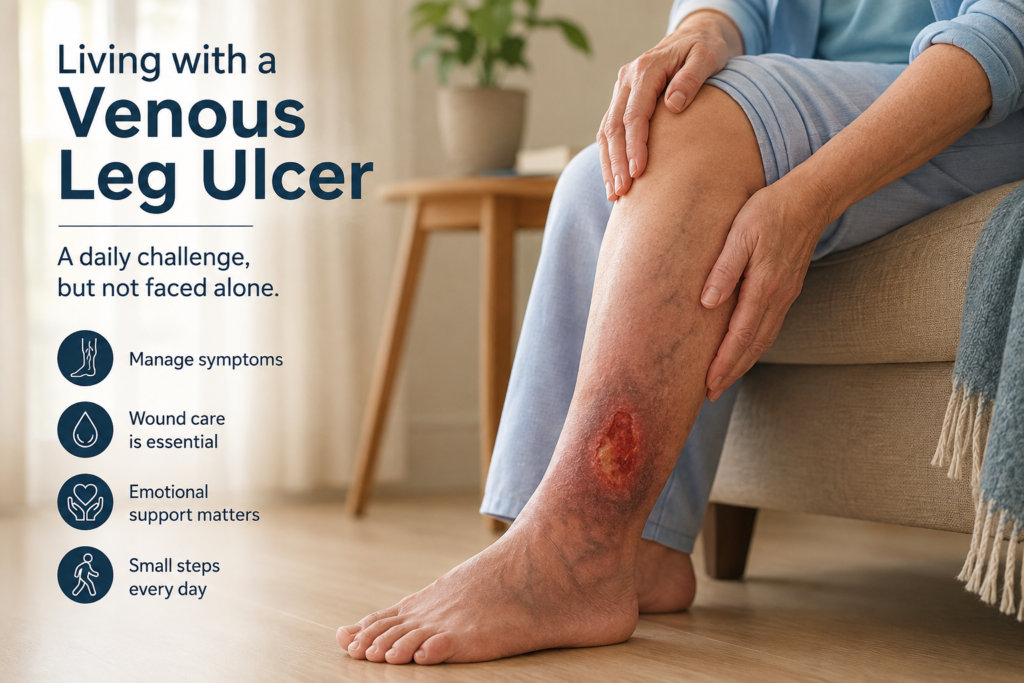
If you have an open sore on your lower leg that has been there for weeks, and the skin around it is discoloured, itchy, or leaking fluid, there is a good chance you are dealing with a venous leg ulcer. It is the most common type of leg ulcer, and it behaves differently from a cut or a surgical wound. Understanding why it happens changes what you do about it.
What is actually going wrong
The veins in your legs have to move blood upward, against gravity, back toward your heart. They do this with two things: one-way valves inside the vein, and the squeeze of your calf muscle every time you take a step.
When those valves stop closing properly, blood slides backward and pools in the lower leg. Pressure builds inside the veins. Over months and years, that pressure pushes fluid and blood cells out through the vein walls into the surrounding tissue. The tissue becomes inflamed, congested, and starved of good circulation. Skin that has been under that pressure for a long time becomes fragile. Eventually a small knock, an insect bite, or a scratch opens it, and it does not close.
That last part matters. The ulcer is the visible symptom. The pressure inside your veins is the disease. This is why cleaning the wound and covering it, on its own, almost never works.
How to recognise it
Venous ulcers follow a fairly consistent pattern.
Location. Usually on the inner side of the lower leg, somewhere between the ankle bone and the calf.
Shape. Shallow, with irregular edges rather than a clean round hole.
Wetness. Often a lot of fluid. Dressings soak through, socks get damp, and there may be crusting.
Surrounding skin. Brown or rust-coloured staining left behind by leaked blood cells. Dry, scaly, itchy patches. Skin that feels hard or tight, sometimes with the lower leg narrowing so it looks like an upside-down champagne bottle.
Swelling. The leg is often puffy, especially by the end of the day.
Pain pattern. A heavy, aching pain that is worse when your leg hangs down and better when you raise it.
That last point is worth memorising, because it separates venous ulcers from arterial ones. Arterial ulcers do the opposite. They hurt more when the leg is raised and ease when it hangs down, because the leg is short of arterial blood and gravity is helping. If your pain gets worse when you elevate, tell your clinician. The treatment is different, and compression can be dangerous.
The one thing that heals them
Compression. Not the dressing. Compression.
Applying graduated external pressure to the leg counteracts the pressure inside the veins, pushes fluid back out of the tissue, and helps the calf pump work again. In study after study, compression is what closes venous ulcers, and the absence of compression is the most common reason they stay open. A well-chosen dressing supports the process by managing fluid and protecting the skin. It does not drive it.
Before compression starts, your clinician should check the blood supply to your leg, usually with a test called an ankle-brachial pressure index. It compares the blood pressure at your ankle to the pressure in your arm and takes a few minutes. If your arteries are significantly narrowed, full-strength compression can reduce circulation to a leg that is already short of it. This check is not optional. If nobody has done it, ask.
Compression comes in several forms: multi-layer bandages applied by a nurse, adjustable wraps that fasten with velcro, and compression stockings. What you are given depends on how much swelling and fluid you have, how much of it you can manage yourself, and what your skin will tolerate.
What you do between appointments
Elevate, properly. Feet up on a footstool does very little. The leg needs to be above the level of your heart for fluid to drain. Lying down with your leg propped on pillows works. Aim for a few sessions a day, around thirty minutes each.
Move your ankle. The calf pump only works if the ankle bends. If you have been sitting still, do sets of ankle circles and point-and-flex movements. Walking is better than any exercise, even short distances indoors.
Do not stand still for long periods. Standing is harder on venous pressure than walking. If your work or your kitchen requires it, shift your weight, rise on your toes, and break it up.
Look after the skin, not just the wound. The skin around a venous ulcer is often dry and inflamed, and the itch is genuinely miserable. A plain, unperfumed emollient on the whole lower leg helps. Scratching opens new ulcers, so treating the itch is treatment, not comfort.
Be alert to reactions. People with long-standing venous disease develop skin allergies to dressings, adhesives, and topical products more often than the general population. If the skin becomes red, weepy, and intensely itchy in the exact shape of the dressing, report it rather than tolerating it.
Eat and drink for healing. Protein, fluids, and reasonable overall nutrition matter to tissue repair. If your appetite is poor or your diet has narrowed, say so. It is a fixable thing that quietly holds wounds open.
What “stalled” looks like
A venous ulcer that is responding should be getting smaller. The benchmark clinicians generally use is a 40 to 50 percent reduction in area after four weeks of proper compression. If that is not happening, something in the plan needs to change. The usual reasons are:
- The compression is not being worn consistently, or is not the right strength.
- There is unrecognised arterial disease.
- Bacteria in the wound are holding back repair.
- It is not a venous ulcer. Not every sore on a leg is, and a wound with unusual raised or rolled edges that has not healed in months may need a biopsy to rule out rarer causes.
None of these are reasons to give up. They are reasons to go back and ask what is being changed. A wound that has been the same size for two months is not being treated, it is being dressed.
After it closes
Healing the ulcer does not fix the veins.
Recurrence without ongoing compression is common, and the majority of people who stop wearing it open up again. Compression stockings, worn daily and long term, are what keep the leg closed. Getting them on is much easier with a donning aid or a silk slip-sock, and they should be replaced every few months as the elastic tires.
Ask about a referral to a vascular service as well. Treating the underlying faulty veins with a minimally invasive procedure can speed up healing and reduce the chance of the ulcer returning. Not everyone is a candidate, but everyone deserves to be assessed.
Call your care team if
- The redness around the wound is spreading, or the leg becomes hot and painful.
- You develop a fever, chills, or feel generally unwell.
- The pain suddenly increases or changes character, especially at night.
- Your toes become cold, pale, blue, numb, or tingly while wearing compression. Remove the compression and get advice the same day.
- Bleeding soaks through the dressing and does not slow with ten minutes of steady pressure.
- The wound is visibly larger or deeper than it was a week ago.
Your own leg, your circulation, and your other health conditions all change the specifics. Treat your care team’s instructions as the ones that count.